
04 July 2025
A Day in the Life of a Thiepval Guide - 1 July 2025
Ever wondered what it's like to work as a CWGF Guide on one of the busiest and important days in the calendar? CWGF Guide Gabi Thomas shares all.
Commonwealth War Graves Foundation Guides
1 July 1916: An important date in British military history
1 July 1916 is one of the days which stands out in British memory of military history. The First Day of the Battle of the Somme remains the bloodiest day in British Military history, and is a day which is often used to summarise the British experience of the First World War.
There were almost 60,000 casualties on that warm summer day 109 years ago, with over 19,000 of them making the ultimate sacrifice.
Heading in to my first week of Guiding at the Thiepval memorial, myself and the rest of the 2025 Guides team knew that it would undoubtedly be a busy day for us, but we approached it with the knowledge we would be involved in a memorable day, not just for ourselves, but also for the visitors to our site.
An early start
Our day started early, with alarms going off at 5:30am to allow plenty of time to get ready and head to our first destination of the day: Lochnager Crater.
From our base in Arras it was around a 40-minute drive to reach the site and by the time we arrived at 7:15 am, traffic at the site was already building up.
After parking we embarked on the short walk from the road to the crater itself. The day was set to be hot, and the temperature was already well over 20 degrees Celsius at this point in the day.
It was at Lochnager that we met up with Lucie Boidin, one of the team at the CWGC Visitor Centre in Beaurains.
The ceremony itself was rather touching. It started at 7:30 am to coincide with the time those men climbed over the top 109 years previously, with whistles being blown to replicate what would have been heard all over the Allied lines along the Somme.
It was this moment that I found the most poignant of the day. Hearing the whistles and knowing the history of that tragic day really focused my mind on why we’d applied for our jobs. Through the first few minutes of the service, I couldn’t help but wonder how many men would have been casualties at this point 109 years ago.
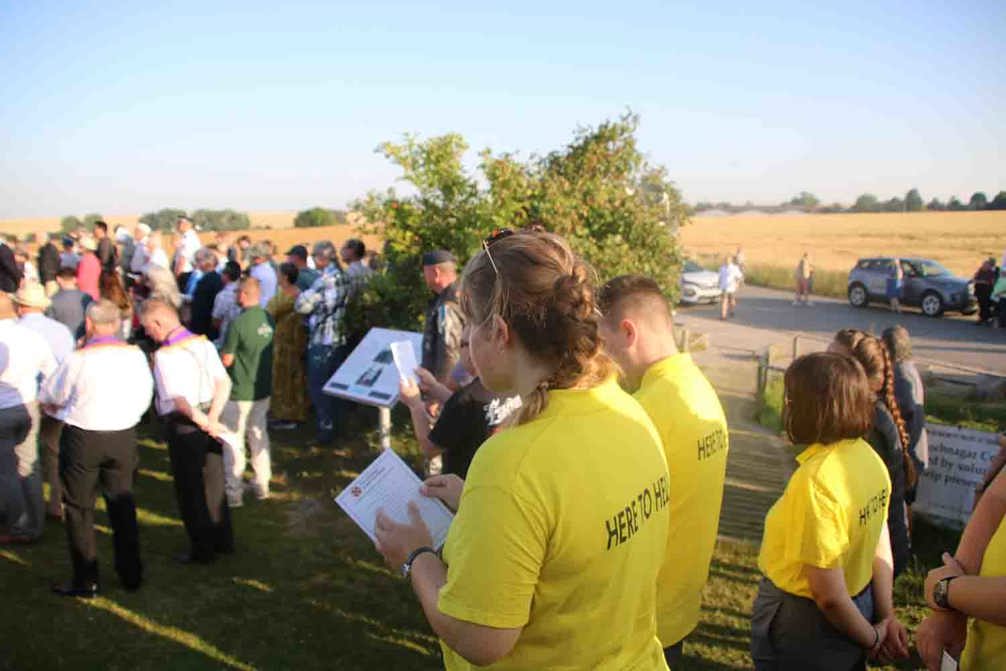
Image: Guides at the Lochnager Crater Ceremony
There were a number of readings through this service, and the spectators of the group were encouraged to join in with the Lochnager Promise and Ode to the Fallen. A number of local mayors attended the ceremony to lay wreaths, as well as some school children followed by a minute of silence.
Our first service of the day ended with a flypast from a 1930s era Tiger Moth (considered more reliable than a First World War plane from the dawn of aviation) dropping papers written with poetry written by children about the conflict.
Following the conclusion of this service, we walked around the edge of the crater, and read the casualty stories written on information boards around the site. It was then time to move on to our second service of the day, and the location where we would spend most of our day – the Thiepval Memorial.
Thiepval: An Iconic Memorial to the Fallen of the Somme
It was only a short drive to the memorial, and our team worked quickly to set up our information tent near the entrance so that we could talk to people as they entered.
We also helped the Royal British Legion (who had organised the service) to finish setting up.
There was no doubt at this point that temperatures were going to stay high, with the weather rapidly closing in on 30 degrees.
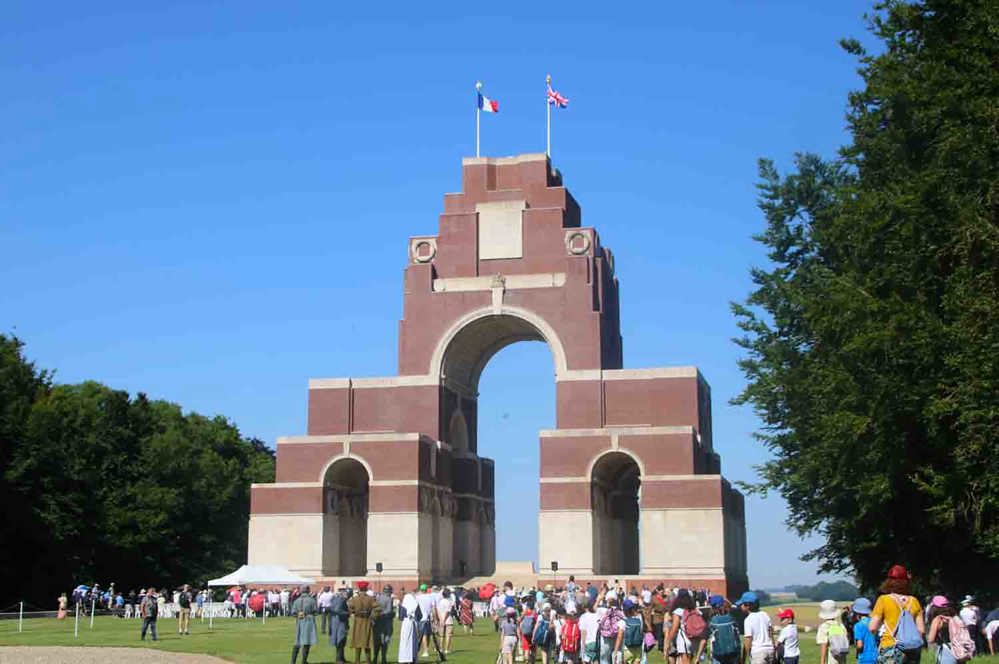
Image: The Thiepval Memorial 1 July 2025 with crowds attending to mark the anniversary of the Battle of the Somme
Armed with brochures on the Commission and plenty of sun cream, we spoke to a number of people as they arrived. We also saw the arrival of key figures in the ceremony, some of whom we would be lucky enough to speak to at the conclusion of the ceremony.
The three hours between the start of our first ceremony and the start of Thiepval’s ceremony flew by, and before we knew it, we were already standing watching it begin.
This memorial ceremony was longer than the relatively short service at Lochnager, and included a speech from the British Ambassador the France, Dame Menna Rawlings. Following this, there was, of course, the laying of wreaths, followed by a minute’s silence. We then listened to both the French and British national anthems to end the ceremony. We would also see the Tiger Moth for the second time that day.
The Thiepval ceremony was the largest of the three we attended on the anniversary, with hundreds of spectators coming to see it. After the ceremony, we were able to meet Jeremy Prince, the CWGC Area Director from France, as well as a handful of other prominent individuals from outside the Commission who had attended on official business.
It was during this ceremony that our group of Guides were the most thankful for our uniforms – designed with summer in mind – as we watched a great deal of people in suits feeling the summer sun in full strength.
Following the ceremony, the majority of visitors left to move on to their next site of remembrance of the day. We spoke to a great number of them about the work of the Commission as they were leaving, with many expressing praise for the ongoing care given to the memorials and cemeteries by the gardeners.
We were to remain at Thiepval for a number of hours before our next ceremony, carrying out our regular day-to-day tasks. The remainder of our day there was taken up largely by helping visiting school groups find names they may have been searching for, and helping their teachers also gain a greater understanding of the memorial.
As is common with school groups, many of the children aren’t searching for anyone in particular, so they default to looking for men who share their locality or surname.
Even if they aren’t looking for a particular person, showing them how to make use of the register to find names is one of my favourite ways to engage with them. There’s always a real sense of accomplishment when they manage to take the information and locate the name on the memorial itself.
We also helped some students who had done a project on a serviceman listed on the memorial to actually find his name. Seeing these students conclude their work by seeing the name of the man they’ve studied and formed a personal connection with is always rewarding.
A large part of my own interest in this period of history is learning the personal stories of the men that served, and it’s something which we try to emphasise on our tours of the site, so seeing a younger generation engage through the same way is genuinely rewarding.
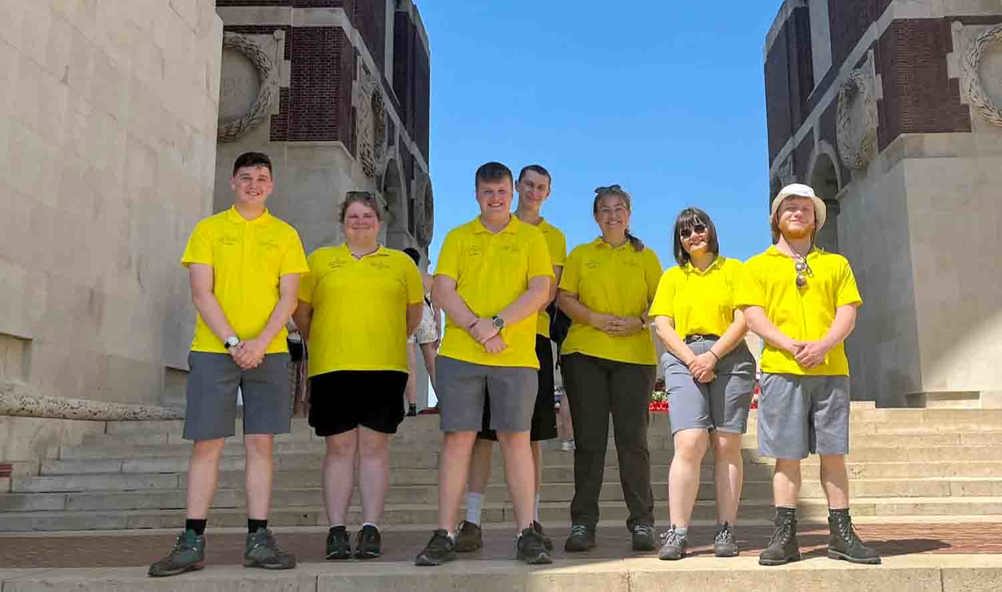
Image: The 2025 CWGF Guides
Beaumont Hamel
Before we knew it, the time had come to pack away our information tent and move on to our final destination of the day. We had decided to finish the day by visiting the Newfoundland memorial at Beaumont Hamel, hosted by our Canadian equivalents.
The drive was short, and we arrived in plenty of time to speak to the Canadian guides about what to expect from their ceremony. By now, the temperature had peaked at 36 degrees and the decision had been smartly made to move the ceremony under a grove of trees near the front of the site, instead of its usual location in front of the iconic Caribou statue, which had little protection from the sun.
The ceremony itself managed to feel both significant and intimate at the same time. Once again, local politicians were present, as well as a handful of visiting dignitaries. There were also teenagers visiting from Newfoundland who were able to get involved in the service.
One of the most touching moments was the reading of the personal diary of a Newfoundland serviceman in the lead-up to the attack. Poetry was read out, as well as two of the Canadian Guides singing the national anthems of Newfoundland, Canada, and France. As with the first two ceremonies of the day, there was also wreath laying and a minute of silence.
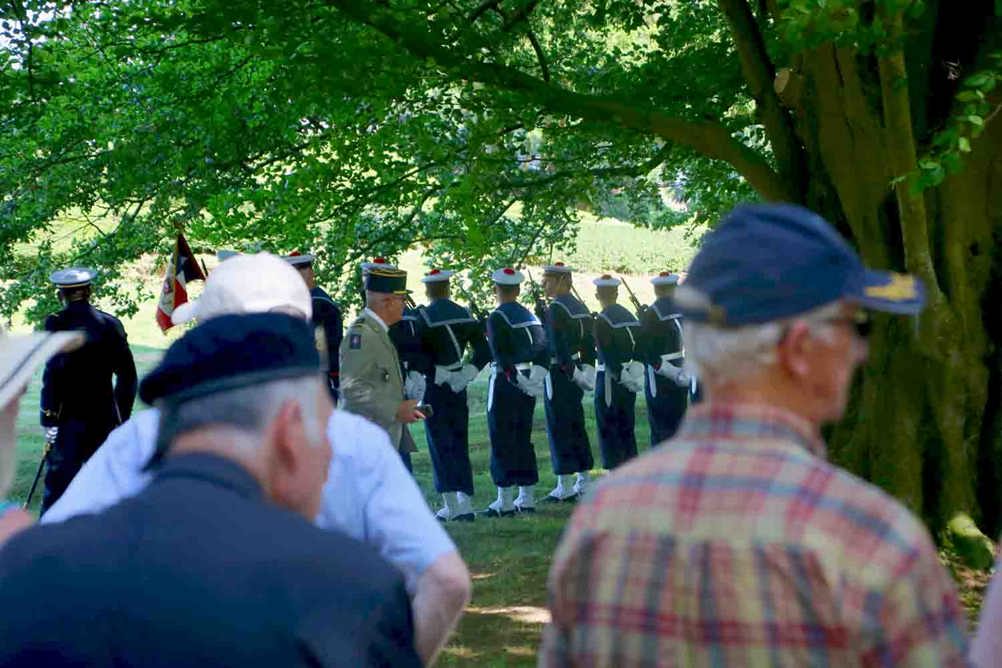
Image: The Beaumont Hamel Service
After this final ceremony, my fellow CWGF Guides and I headed back to our accommodation, contemplating the events of the day.
All three ceremonies had been different but equally touching. They also managed to focus on different aspects of the Battle of the Somme, meaning that the day hadn’t felt repetitive at any point, despite any crossovers that may have happened.
Although I’m only at the start of my tenure as a Guide, I’m confident that this day will be one of my strongest memories of my time on the Somme.
As a group, we got the opportunity to speak to so many different people: from politicians, military and people who attend annually, to people who had never seen the sites before. We even spoke to some tourists with only a vague interest in the topic and had managed to pick such an important date by chance and wanted to know what the Thiepval ceremony was all about.
I feel genuinely honoured to experience this opportunity, and despite the heat I hope that it sets the tone for my summer.
Want to support the Commonwealth War Graves Foundation Guides Programme? Donate Today
The Commonwealth War Graves Foundation Guides Programme gives young history lovers an opportunity to work for Commonwealth War Graves in France and Belgium.
They welcome visitors, share the incredible stories of those commemorated by Commonwealth War Graves, and assist our guests on their journey of remembrance at important sites on the Western Front.
We’re passionate about preserving the memories of the Commonwealth’s war dead and interacting with young people to keep their stories alive. Our Guides help us in our core mission while becoming equipped with real-life skills to aid their personal development.
Our Guides Programme relies on your generosity.
£100 could pay to fully train one of our Guides ready for their experience of working abroad so they are best able to welcome visitors, share the incredible stories of those we commemorate, and help assist visitors on their journey of remembrance.
Please donate to the Commonwealth War Graves Foundation today to keep projects like this going.
Donate Online Now
By donating to the Commonwealth War Graves Foundation, you are helping us to keep the stories of the brave servicemen and women who died in the two World Wars alive. Can you help us ensure that their sacrifice is not forgotten?

Your donation enables us to continue sharing the inspiring stories of those like Ensign Violette Szabo, a brave SOE operative and spy who was executed in Ravensbrück concentration camp and posthumously awarded the George Cross. Violette is commemorated at our Brookwood Memorial.